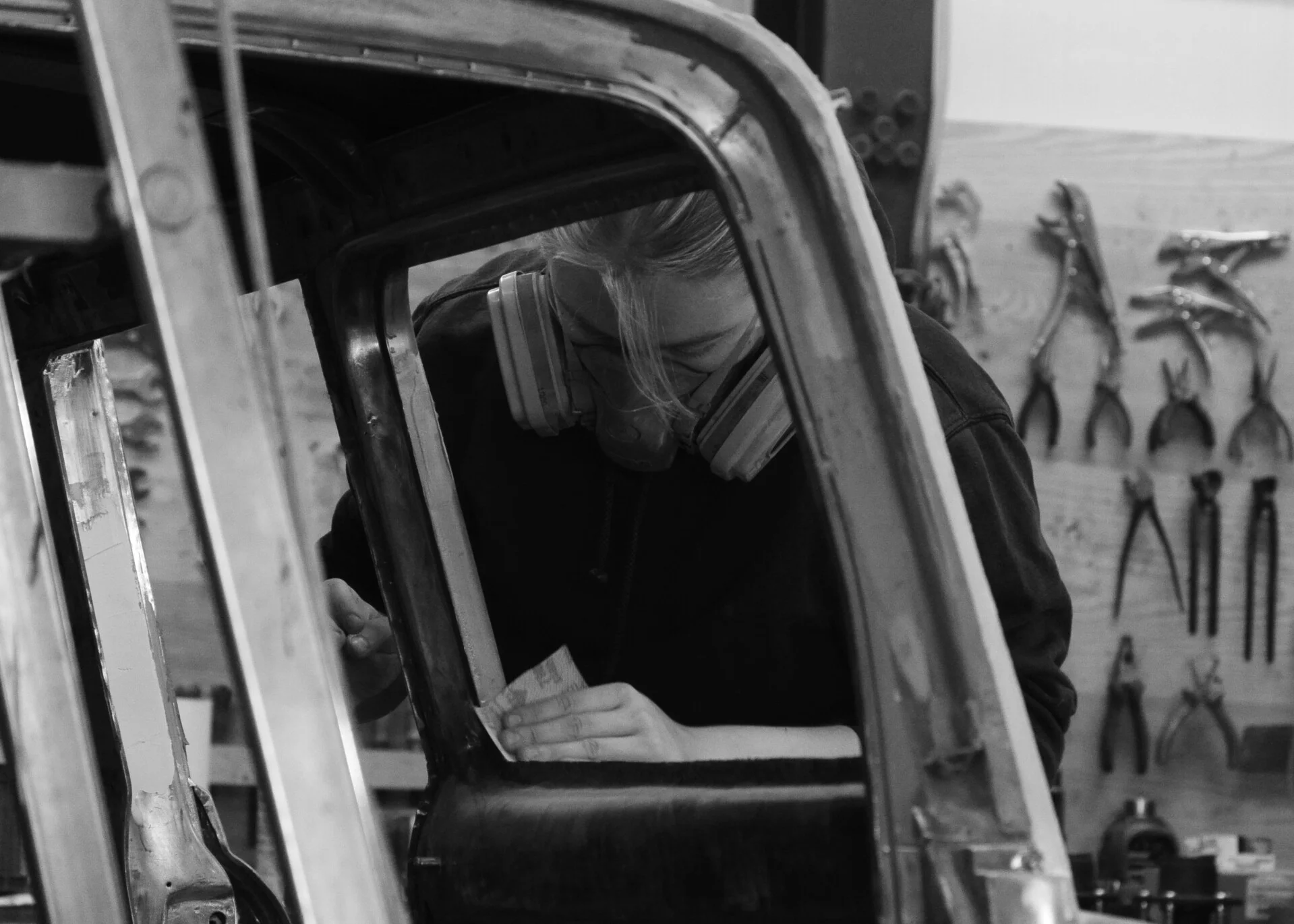
Craftsmanship from A to Z
Behind every completed restoration lies a series of disciplines, each demanding its own precision. From the panel work to the smallest carburettor rebuild — this is where my craft shows itself in practice. Below is a look at how I work, discipline by discipline.
Welding and metalwork
My specialisation lies in large and complex projects: full restorations, or projects that come close to them. Not because smaller jobs do not suit me, but because my way of working requires the room to do it properly. I tackle the cause, not the symptom. Welding up a rust spot without understanding why it is there is merely postponing the inevitable.
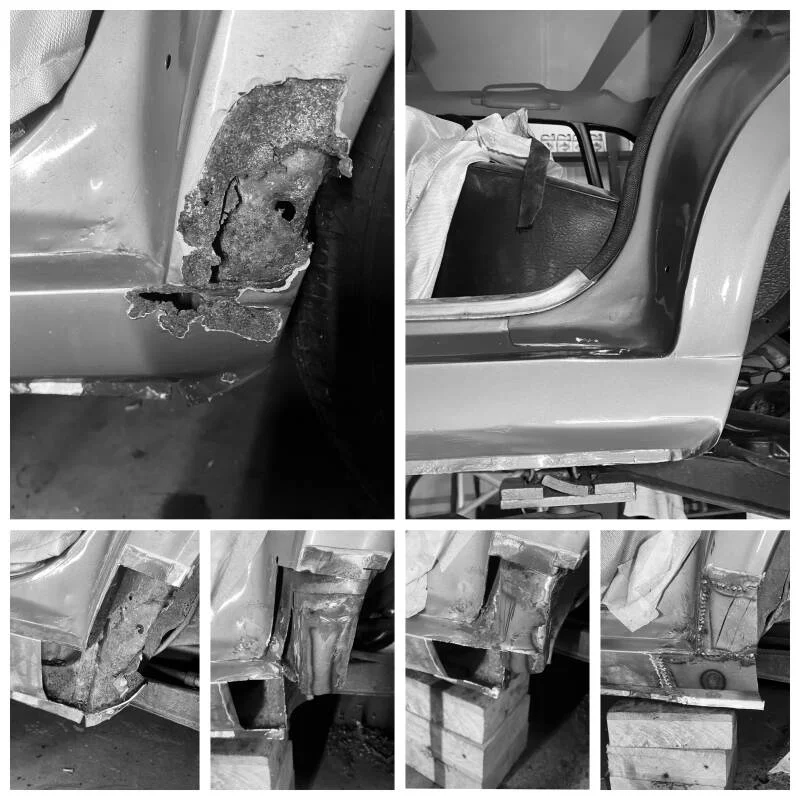
A good example is a Saab convertible that came to me with rotten sills. Those sills are built up from three box sections, and now that these had rusted away the car had lost its structural rigidity. The roof could no longer be opened without the doors starting to sag — a well-known problem with these convertibles. Most people had written it off, but that is exactly what I struggle with. A car is rarely just steel. It is thousands of kilometres of adventure, people you have driven with, a previous owner from whom you were able to take something over. Ultimately, no one else can decide for you whether a car is still worth it — whether that value lies in the metal or in the memories.
Rust on load-bearing parts is therefore not merely a cosmetic problem. It affects the rigidity and structural integrity of the body, in box sections, sills and chassis joints. And that ultimately makes it a safety issue that I take seriously.
I work with the original as my starting point, but restoration is more than copying. Taste is a full part of the process. A classic car should be loved, and may therefore also be modified, as long as this is done with an understanding of what the car is at its core. Practical improvements, a personal choice of colour, a detail executed slightly differently from how it left the factory — that is all part of a car's life. My goal is for this car to still be on the road in thirty years' time, and to be just as loved then.
Lead loading
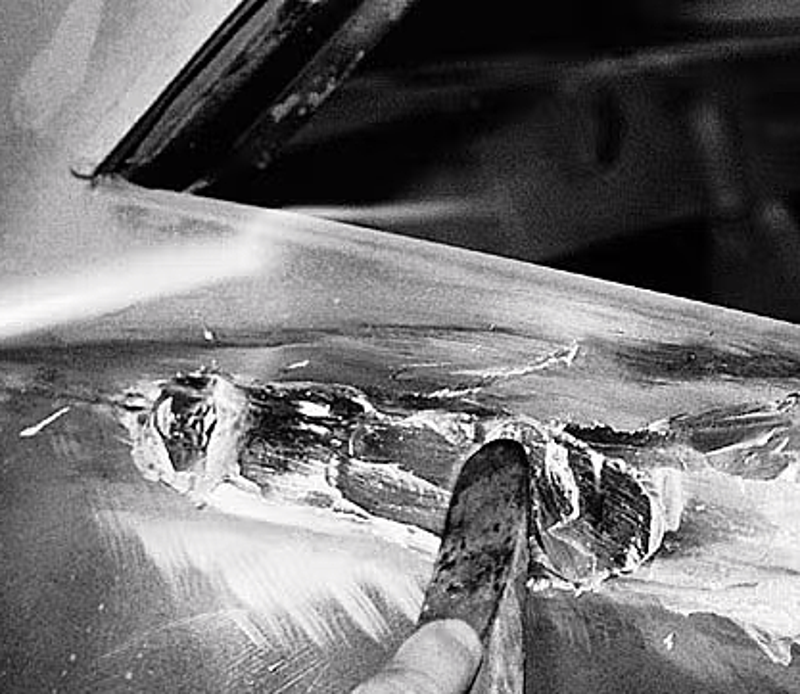
Lead loading is the traditional method of finishing weld seams, a technique that has largely been replaced by body filler. That is understandable in terms of speed and cost, but technically the two are not equivalent. Whereas body filler bonds mechanically to the surface, body solder, when applied correctly, forms a metallurgical bond with the steel. The loaded layer also seals the steel very effectively from moisture and oxygen, greatly inhibiting corrosion. A loaded seam copes better with temperature changes, vibration and slight movement of the panels. As a result, a well-loaded repair remains more stable in the long term.
My finest lead-loading project was a Volvo P1800 belonging to a client with whom I immediately clicked. I had just learned the technique on the Amazon. On this P1800 I was able to put this expertise to full use in a purist restoration: an approach in which history and craftsmanship are respected down to the last detail.
When he asked whether I would lead-load his classic, it moved me — not only the trust he placed in me, but also our shared appreciation for the craft itself. That project taught me what it means to pass on craftsmanship, and what it is worth when that dedication is recognised.
Body filler is not bad by definition — for certain applications it is a perfectly good solution. But for finishing weld seams on a classic car, I find body solder the more honest and durable choice. The process is slower and requires more skill, and that is exactly why it is important to keep mastering and applying this technique.
Gearbox rebuild
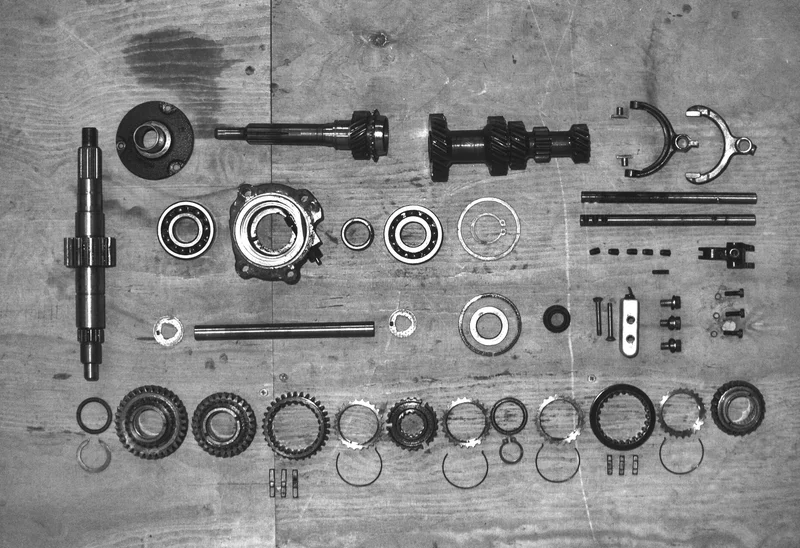
As the owner, you are usually the first to hear or feel that something is changing: a noise at speed, a gear lever that no longer slots in smoothly or play that was not there before. That gut feeling is often right. When you come to me with that observation, I translate your suspicion into a clear, concrete diagnosis.
For me, a rebuild therefore means more than just fixing a defect; it is about restoring that original, tight mechanical feel. I work strictly to the original factory specifications to accurately measure and adjust end float, bearing loads, synchromesh and the exact tooth contact pattern. Where necessary, I supplement this data with the expertise of specialists in my network.
With that combination of thorough diagnosis, factory information and craftsmanship, you get exactly the clarity you need. That is how I return the mechanism to the state its engineers once intended.
Carburettor rebuild
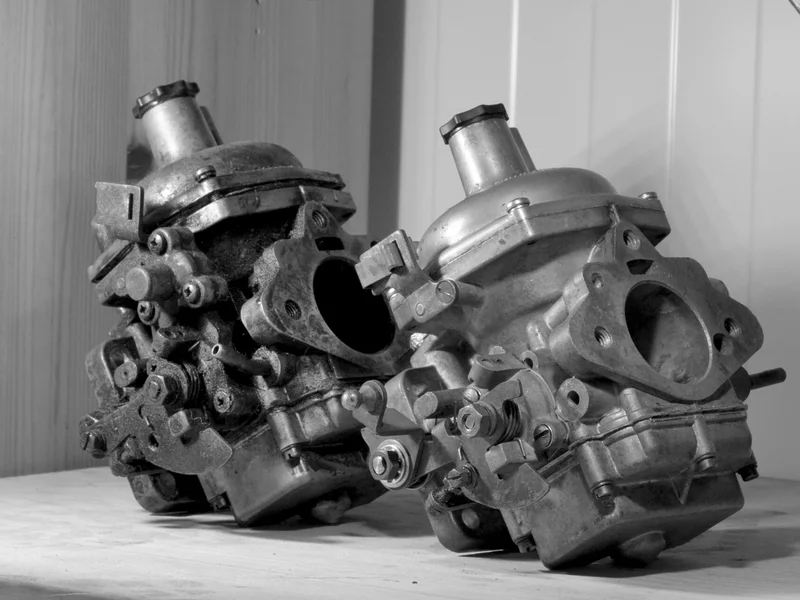
As a driver, you often feel it immediately when the engine is no longer running at its best. The car responds slightly less keenly, the engine shakes a little at standstill or starting suddenly takes more effort. That signal is almost always right. When you come to me with that observation, I translate your experience into a targeted diagnosis of the carburettor.
Especially with a constant depression carburettor such as the Zenith-Stromberg (the 'CD' in 175CD) — a type of engineering in which my particular interest lies — it is all about precision. In my view, a quick fix with just a service kit is rarely enough. I go back to the original factory specifications and critically assess the needle, jet holder, throttle spindle and float mechanism for wear.
Differential rebuild
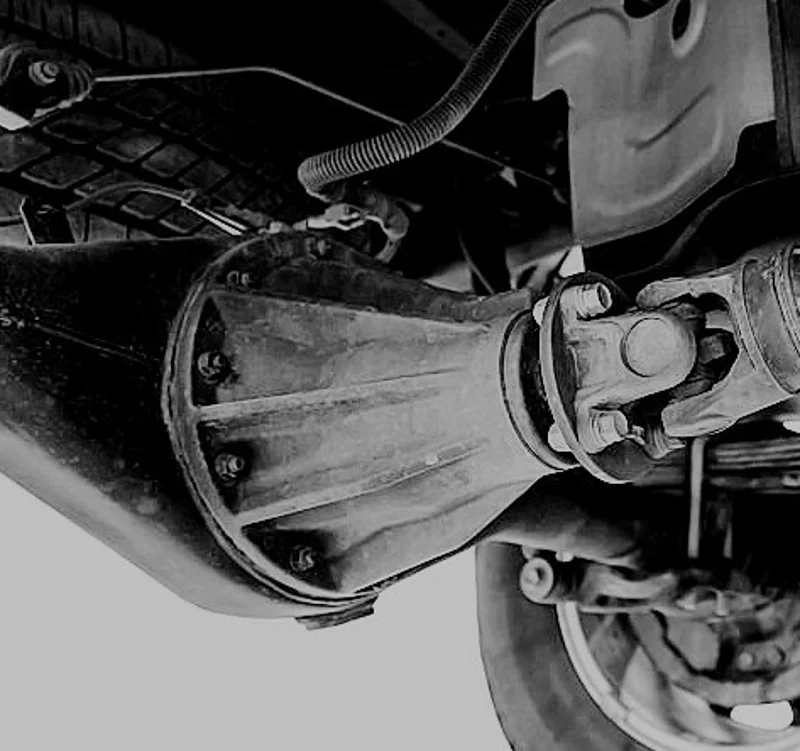
As a driver, you know your car inside out: a subtle vibration, a slight hum at speed or a clunk under full load is noticed immediately. Your gut feeling is almost always right. The differential is one of the most heavily loaded components of a classic car, and your observation is my direct starting point for a targeted diagnosis.
I use your experience on the road as my compass in the workshop. Better to intervene in good time and in a targeted way, before a small noise turns into costly consequential damage in which bearings, crown wheel, pinion and half shafts are overloaded. My aim is not only to repair something when it breaks, but to proactively keep the mechanics in top condition. In my view, merely replacing bearings and oil seals therefore does not produce a lasting result. With this type of mechanism, everything revolves around absolute precision and respect for the engineering.
I only consider a rebuild successful once the mechanical balance has been fully restored. I thoroughly dismantle, clean and inspect all components.
Following the factory specifications, I set the correct bearing preload, align the backlash exactly and check the contact pattern down to the smallest detail. It is meticulous and time-consuming work — a craft of great value.
Whether it is welding, lead loading, or rebuilding a gearbox, carburettor or differential — all these disciplines interlock seamlessly. Every component receives the same specialist attention, whether it is a single targeted job or a full restoration. Thoroughly understanding what is going on mechanically always comes before dismantling or replacing. That is the standard I stand for. This way your classic not only remains reliable on the road, but also retains its original driving characteristics. That is exactly what drives me, and why every day in the workshop begins with the same dedication as the day I discovered this trade.